
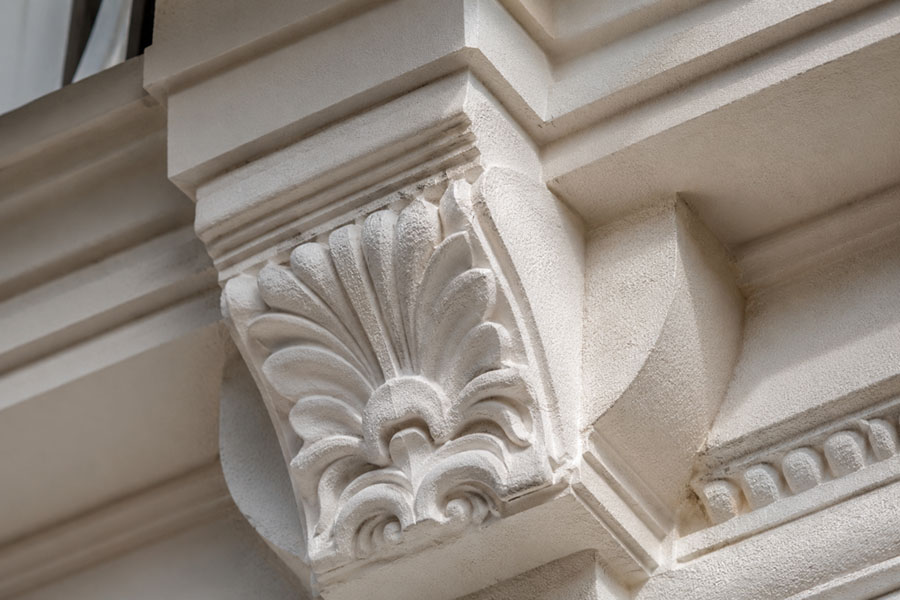
EPS foam lets architects create intricate custom details that traditional materials often make too heavy, expensive, or difficult. Here’s what actually becomes possible and why more teams are using it.
Architects run into the same wall all the time. You have a clear picture in your head — maybe an arched entry, a running band of ornament, or a column capital that actually feels custom — and then reality hits. Stone is too heavy. Cast concrete is expensive to form for anything intricate. Wood needs constant maintenance. The detail gets simplified, value-engineered, or dropped entirely.
EPS foam changes that equation in ways that actually show up on site.
What Becomes Possible with EPS Foam
The material is lightweight and easy to shape. That single fact opens up a lot of doors that used to stay closed.
You can do deep relief work, repeating classical profiles, or completely custom sculptural elements without adding serious dead load to the structure. On a renovation or addition, that matters. On new construction where every pound counts toward the foundation and framing, it matters even more.
Common details that work well include:
- Arches and keystones
- Running cornices and friezes
- Column capitals and bases
- Window surrounds and pediments
- Balustrades and handrails
- Medallions and decorative panels
- Sculptural or thematic elements that still need to feel architectural
Because the foam can be molded or carved before any coating goes on, you get crisp edges and fine detail that would require expensive formwork or hand carving in heavier materials.
How It Compares to Traditional Materials
| Material | Weight | Cost for Complex Shapes | Installation Speed | Maintenance | Design Flexibility |
|---|---|---|---|---|---|
| Stone | Very High | Very High | Slow | Low | Low |
| Cast Concrete | High | High | Medium | Low | Medium |
| Wood | Medium | Medium | Medium | High | Medium |
| EPS Foam | Very Low | Low to Medium | Fast | Low | High |
The table doesn’t tell the whole story, though. The real advantage shows up when you’re trying to do something that doesn’t fit neatly into standard details. That’s where EPS foam stops being “just another option” and starts solving problems.
Real Benefits on Actual Projects
The lighter weight is the obvious one. Less weight means smaller structural members in some cases, and it almost always means faster and safer installation. Crews aren’t wrestling with heavy pieces on scaffolding.
Cost is another factor. For highly custom or one-off details, the forming costs for concrete or the material and labor for stone can get ridiculous fast. EPS foam lets you get close to that level of detail for less money in most cases.
Speed matters too. Once the shapes are made and coated, they go up quickly. That helps when you’re trying to hit a deadline or when the building is already occupied and you need to minimize disruption.
The finish quality can also be excellent. With the right coating system, EPS foam can look like stone, concrete, or even wood from a normal viewing distance. It won’t fool someone up close who knows what they’re looking at, but for most architectural applications that’s not the requirement.
Where It Actually Gets Used
On commercial and hospitality work, EPS foam shows up in exterior ornament, entry features, and running details where the alternative would have been too heavy or too expensive. On multi-family projects it’s often used for repeating elements across multiple buildings because the cost per unit drops and the consistency is easier to maintain.
Interior applications are also common — ceiling medallions, wall panels, and decorative beams where weight is a concern or where the existing structure can’t take much additional load.
The material works best when it’s part of a larger system. Pairing it with precast concrete for structural elements, for example, lets you get both performance and detail without forcing everything into one material.
A Few Honest Limitations
EPS foam isn’t the right answer for everything. It needs proper coating and detailing at transitions to perform well long-term, especially on exterior work. It’s not structural on its own in most cases. And if the detail needs to take real physical abuse or constant contact, something harder is usually better.
That’s why the best results usually come from projects where the design team and the fabricator talk early. When you know what the material can and can’t do, you can design to its strengths instead of fighting its limits.
How to Get Started on Your Own Project
If you’re looking at a detail that feels too complicated or too heavy in traditional materials, EPS foam is worth running by someone who actually fabricates it. The conversation usually goes better when you bring photos or sketches of what you’re trying to achieve rather than just a material spec.
The real question isn’t usually “Can we do this in foam?” It’s “Does this detail actually need to be heavy, or are we carrying extra weight for no good reason?”
Want to explore custom architectural foam details for your project? Request your Consultation or Quote with Magic Design in Orlando.
Related Reading
Precast & Architectural Foam Solutions
About Magic Design
Magic Design Architectural Projects
Frequently Asked Questions
Is EPS foam durable enough for exterior architectural details?
Yes, when it’s properly coated and detailed. The foam itself is the core, but the coating system does the heavy lifting for weather resistance. Done right, these details hold up well for decades with normal maintenance.
How does EPS foam compare to traditional stone or precast for custom work?
It’s much lighter and usually faster and cheaper for intricate shapes. Stone and precast are better when you need real structural mass or extreme durability in high-abuse areas. Foam wins when weight, speed, or complex geometry is the bigger issue.
Can EPS foam be used on historic or traditional-style buildings?
Absolutely. Many restoration and new traditional projects use it for cornices, medallions, and ornamental work because you can match historic profiles without adding serious weight to older structures.
What kind of finishes can you get with architectural foam?
You can get finishes that look like stone, concrete, wood, or even metal, depending on the coating. The texture and color are applied after the shape is made, so the design flexibility is high.
How does the cost compare to other materials?
For custom or complex details, EPS foam is often more cost-effective than stone or heavily formed concrete. The savings usually come from lower material weight, faster installation, and reduced structural requirements.
Can you combine EPS foam with precast concrete on the same project?
Yes, and we do it often. Precast handles the structural or larger elements while foam takes care of the lighter, more decorative details. It keeps everything under one team and reduces coordination problems.
How long does it take to get custom EPS foam details made?
Lead times are usually shorter than stone or custom precast because the forming process is simpler. Exact timing depends on the complexity and quantity, but it’s one of the faster options for custom architectural work.
Does EPS foam require special maintenance?
Not really. Once it’s coated properly, it mostly needs the same kind of periodic cleaning and inspection as other exterior materials. The coating is what you’re maintaining.
Is EPS foam a good option for interior architectural details too?
Yes. It’s commonly used inside for ceiling medallions, wall panels, beams, and decorative trim where weight is a concern or where you want crisp detail without heavy materials.
Can EPS foam be used in high-wind or coastal areas?
It can, as long as the coating system and attachment details are designed for those conditions. We’ve used it successfully on projects in Florida where wind and moisture exposure are factors.
